Circle L’s Chuck Wagon~Chugwater Chili

Chugwater is not only my home town it is the home of the famous Chugwater Chili.  The founding of Chugwater Chili Corporation is a story of real small town values at work.  Chugwater Chili Corporation was formed by a bunch of my neighbors in 1986.  They purchased the Wyoming State Championship Chili Recipe, with the goal of helping the business community in Chugwater. 


We love Chugwater Chili!


It is a spice that I use on almost everything I cook.  

Beef and Chugwater Chili are a perfect match!  

A bowl of Chugwater Chili warms your soul.

To order please see their website:  http://chugwaterchili.com/index.html or send me a message and I will ship it to you.

See below for Chugwater Chili Recipe.
If you are interested in the history of Chugwater see their site: http://www.chugwater.com/history.asp

Print Recipe
Chugwater Chili
I serve Chugwater Chili with Cheese and Crackers.  I also sometimes add a can of diced canned tomatoes into my chili.Left over Chugwater Chili can be used for Chili Dogs, Chili Frito's with cheese and Taco Salad.
Servings
People
Ingredients
Servings
People
Ingredients
Instructions
  1. Brown 2 lbs of ground beef; drain excess fat. Stir in 3 Tbsp. Chugwater Chili Mix (more for hotter chili), one 15 oz can tomato sauce and 15 oz water. Bring to a boil. Reduce heat, cover and simmer 30 minutes, stirring occasionally. Add two 15 oz cans plain pinto beans; return to simmer. Serve Hot. Recipe makes 9 one cup servings
Share this Recipe
Categories
Shine On Shine On Ag

Shine On~Women in Agriculture~Nicole Rodriguez

Shine On~Women in Agriculture~Nicole Rodriguez

Shine On, Shine On was the subject of a blog post that I did a while back.

Here is the link to my first Shine On, Shine On post!  I have decided that there are a lot of people that help me “Shine” and I am going to feature them on my Shine On, Shine On series.

This year I decided to start a new spin on my Shine On series and add a little more of agricultural spin. I am excited to be bringing you these interviews. My goal is to share these fine ladies stories with you all.  Help me welcome my this Shine On Lady, Nicole.

From historic homesteaders to contemporary cattle ranchers, women have been the cornerstone of America’s agriculture heritage. In fact, the 2012 Census of Agriculture notes that nearly 1 million women are working America’s lands. That is nearly a third of our nation’s farmers.  Women are also scientists, economists, foresters, veterinarians, and conservationists. Women are in the boardrooms and the corner offices of international enterprises, and are the owners and operators of small businesses. Women are property owners and managers. Women are policymakers and standard bearers. Women are involved in every aspect of agriculture.

Shine On~Women In Agriculture featuring: Nicole Rodriguez


Please tell us a bit about yourself and your career path.
I’m a second career dietitian who’s passionate about empowering consumers to feel good about the foods they’re buying, regardless of budget. I have a background in communications and was formerly a sales executive in the beauty industry.

Tell us about your role and what does your “typical day” looks like.
Days vary, but are a mix of client appointments (both nutrition and personal training), client check-ins, and working on the app on which I serve as in-house dietitian (NavaFit). Additionally, I invest a minimum of an hour on social media each day. Oh, and of course there’s my (almost) four year old and husband!

Who is/was your biggest influencer or mentor? What did you learn from them?
Leah McGrath, Cindy Chan Phillips, and Rosanne Rust are my top three RD role models. I love each of their unique spins on agvocacy. I’ve learned quite a bit from each of them, mainly via social media.

How do you define personal success? How are you working to get there?
Personal success is finding balance between career satisfaction and a happy home life. Trusting my gut and stressing less have both helped me better define what success looks like for ME and not comparing myself to others.

How do you think a women’s role(s) in farming/ranching/agriculture has changed over the last decade?
Women have gone from the farm/ranch wife to the ones ruling the roosts! Meeting female ranchers is what inspired me to take my role as an advocate for beef more seriously. Though our lives are quite different, our end goal is the same: providing safe, wholesome, and delicious food to our families. I’ m so very thankful for everyone who plays a role in bringing beef from pasture to plate!

Learning from our mistakes is an important part of life. Would you mind helping others and share a mistake that you have made and what it taught you in the process?
Be careful to whom you lend your credential and expertise. Take care in choosing projects to which you truly want your name attached.

How would you define “women in agriculture” or “women in your career”?”
Women in dietetics seem to have a great entrepreneurial spirit. It’s a field we dominate!

What in your opinion, is the most important topic in the agriculture world right now?
Oh dear…where to begin! Living in an urban area, I hear so many misconceptions about agriculture. GMOs continue to be a hot topic, although the evidence overwhelmingly proves their safety. From a RD perspective, labeling is a related important topic with ties to agriculture. Groups such as Peel Back the Label are doing a great job clearing up some of the confusion.

What is in your daily toolbox? Planner? Phone? Computer? Special item(s)? Why do you carry it with you?
I am never without my phone! It feels like a bit of a leash but it’s much easier than carrying a tablet or laptop as I spend much of my time on the go.

In closing, do you have any advice, quotes for young women, or anyone that is starting their career in agriculture?
To dietitians: take any and every opportunity to get to know the people who are growing our food. Make it your business to better understand the technology of modern agriculture.

Is there anything you would like to add?

If it didn’t come from cattle, it’s not a burger. If it didn’t come from a lactating animal, please don’t call it milk.

“Enjoy your beef! Enjoy your life!” ~Nicole

Nicole~Thank you for taking time out of your day to answer a few questions. I am lucky that our paths crossed. 

Here are a few more reasons that you help me Shine On:

🌟I love your attitude. You differently made a difference in my life.

🌟 I love your knowledge about eating healthy and your way of thinking!! “Just eat the brownie!”

🌟I appreciate your efforts in teaching people the “truths” about their food they eat and not to buy in on fear marketing.

🌟Your a hard worker and it shows.

🌟Your beautiful inside and out.

🌟I admire you expertise on nutrition and life. 

🌟This quote from you, “Beef-Protein meet pleasure”, made my whole entire year!!

🌟Strong women stand together when things get rough, hold each other up when they need support, and laugh together when there’s no reason to.

When I think of you, this quote comes to mind:

“Focus on where you want to go, not on what you Fear” – Anthany Robbins

My message to you, dear friend is Shine On!!

Thank you for just being YOU!~Naomi


You can find Nicole on:

Twitter

Instragram

Website

Categories
Antibiotic Resistance antibiotics Antibiotics Stewardship Beef Beef it's Whats For Dinner

Why I’m Not Scared to Eat Beef That Isn’t “Antibiotic-Free”

Why I’m Not Scared to Eat Beef That Isn’t “Antibiotic-Free”

Antibiotic Free, Antibiotic, Beef, Don't Eat Beef

O my word, why would I, a cattle rancher, use antibiotic and beef in the same sentence, let alone a title to a blog post?

Well, I got your attention right?

Let me tell you this:

THERE ARE NO ANTIBIOTICS IN BEEF!

Let me tell you that again:

THERE ARE NO ANTIBIOTICS IN BEEF!

I know, I know the media and marketers say. And I know that food labeling can be confusing. But didn’t you ever hear the saying, “Don’t believe everything the media and marketers say”?

The media and marketers like to “scare” the crap out of you and tell you things that are not entirely true.

Yep, they do it every day. And to tell you the truth, I am getting tired of the “scare” type of marketing. I would like to tell every business that uses it this: “Don’t you know where liars go?” But that’s for another day story.

Anyway, while I have your attention let’s talk a little about antibiotics in animal production.

Yes, we and by that I mean farmers, ranches, and anyone else who takes care of animals, use antibiotics. You know what else we do? We work with our veterinarian. We keep records on all of our animals. And records for the animals that have been given treatment with antibiotics include which medications we used and how much we gave. Because before an animal treated with an antibiotic is allowed to be harvested for meat, it must go through a withdrawal time.

The withdrawal time, which varies based on the type of antibiotic given and the amount (dose), ensures that the antibiotics are out of the animal’s system before it enters our food supply. (Want to know more about withdrawal times check this out from Beef Magazine.)

Furthermore, it should come as no surprise that there are even more specific government regulations other than withdrawal times that ensure our meat is antibiotic-free when it hits our tables. (Don’t believe me? Here is the link..) I believe that everyone in animal production does a fine job keeping antibiotic residue out of the food chain.

For these reasons, I am not even a little bit scared to eat beef that isn’t “antibiotic-free” because it’s all antibiotic-free. And for the record, I eat and feed my family pork, poultry, fish, sometimes, because I believe in those products as well.

Besides all that, here are 5 more reasons beef has a place on our plates.

  1. Beef is Healthy-Beef provides nutrients like zinc, iron, choline, selenium, phosphorus, niacin, riboflavin, protein and B vitamins, and half of the fat found in beef is monounsaturated, the same heart-healthy fats found in olive oil.
  2. Beef is Super Easy to Cook for my family– Because beef is an easy addition to well balanced meals. Do you need Beef recipe ideas? Check out Circle L Chuckwagon, Beef…It’s What’s For Dinner and FaithFamily and Beef 
  3. Beef is good for our environment. Yep, I have proof. You see, the land on Circle L is not suitable for farming. It is suitable for cattle. The cycle of cattle ranching is really easy, the cows eat the grass. The grass they eat turns to poop. The poop is fertilizer that helps grow more grass. The cows get fat and raise calves and the cycle continues every day.
  4. Beef helps your muscles grow. Mom used to say, “Eat your spinach so your muscles will grow!” My mom is dead, but I really want to tell you that I would rather have Beef on my plate than spinach. In all seriousness, beef is really rich in ammonia acids which increases our muscle mass. As a mom, to four ranch kids, I know that feeding them beef will not only help them get muscle mass, it will also help them to have energy to succeed in their school studies and at sports.
  5. Beef makes my waistline smaller. Yes, you read that right. I have been doing a no carb diet for months now and by that I mean, I am not taking any pills or shakes, just not eating any carbs. I have been eating mostly beef with cheeses and vegetables. I feel the best I have ever felt and my jeans are loose.

There you have it, all beef is safe, wholesome, nutritious, AND antibiotic-free. So next time you have questions, please come to me – a real-live-rancher who honestly knows more about the beef than the media, marketers, and Google.

Categories
Beef

Trick or Beefy Treat

Trick or Beefy Treat –
Pass out Beef Jerky This Halloween

Ready for a Halloween Candy AlternNo automatic alt text available.ative?

Halloween is just around the corner, and for many it means that we all head to the local store to buy candy for all the ghost and goblins that will come knocking on our doors Halloween night. But wait, before you head to the store let me tell you about another option that I think all the kids will like.

Beefy Jerky including Beef Jerky Sticks.

Yes, you read that right. Why not pass out beef jerky to all the kids!

Beef jerky is a healthy, hunger-satisfying protein for everyone. The drying process is beneficial in a couple of ways: it requires getting rid of excess fat (as it could go bad without refrigeration) so you’re left with a low-fat product, and the water lost concentrates the protein in the meat to nearly double its amount in the same portion of uncured meat. Beef jerky also has healthy dose of zinc and iron in it. Snackers are turning to jerky as a satisfying alternative to munchies like chips or bars.

Beef jerky comes in many handy options like: sticks, slaps and pieces.

Our families’ choice of Beef Jerky/ Beef Jerky Sticks (Yes, we voted!):

Centennial Cuts Beef Stick- “Sustainably raised Premium Beef. Born, raised and harvested in Colorado – handled with care by Colorado employees from day 1 – all the way to your plate!” (Give all their products a try! They are amazing.) Available at www.centennialcuts.com.

Fat Joe’s Jerky- “Our regular beef jerky is seasoned, marinated, smoked, and dried to perfection before packaging. It has a small amount of Red pepper for heat but not much at all.” (We loved the Original but the Mild was also amazing.) Available at www.fatjoesjerky.com.

Circle L’s Homemade Jerky- Cody does a fine job in making our own jerky. This is what he does: he marinates a beef eye of round roast (to tell you the truth thou, he has used all beef cuts including hamburger). His marinating sauce contains soy sauce, black pepper, and brown sugar, Chugwater Chili spice, and Lowry’s Seasoned Salt. (He sometimes adds red pepper for some heat.) He slices it thin, and lets it dry out in the oven at 160˚ F for 6-8 hours. Homemade jerky technically lasts for about three months (we store it in the refrigerator), but you can freeze it indefinitely until you’re ready to eat it.

In preparation for Halloween night, I am suggesting to you all to try something a little different this year. When your trick-or-treaters arrive, they will be thankful for the healthy, protein filled snack.

Once the night comes to a close, give yourself a pat on the back – you gave your trick-or-treaters a happy (and healthy!) Halloween treat and you are helping the beef community out.

Happy Halloween from the Circle L!

Lastly, if my “Trick or Beefy Treat” post helped you out an any way, make sure you share it by clicking those funny looking social media buttons.

Categories
Uncategorized

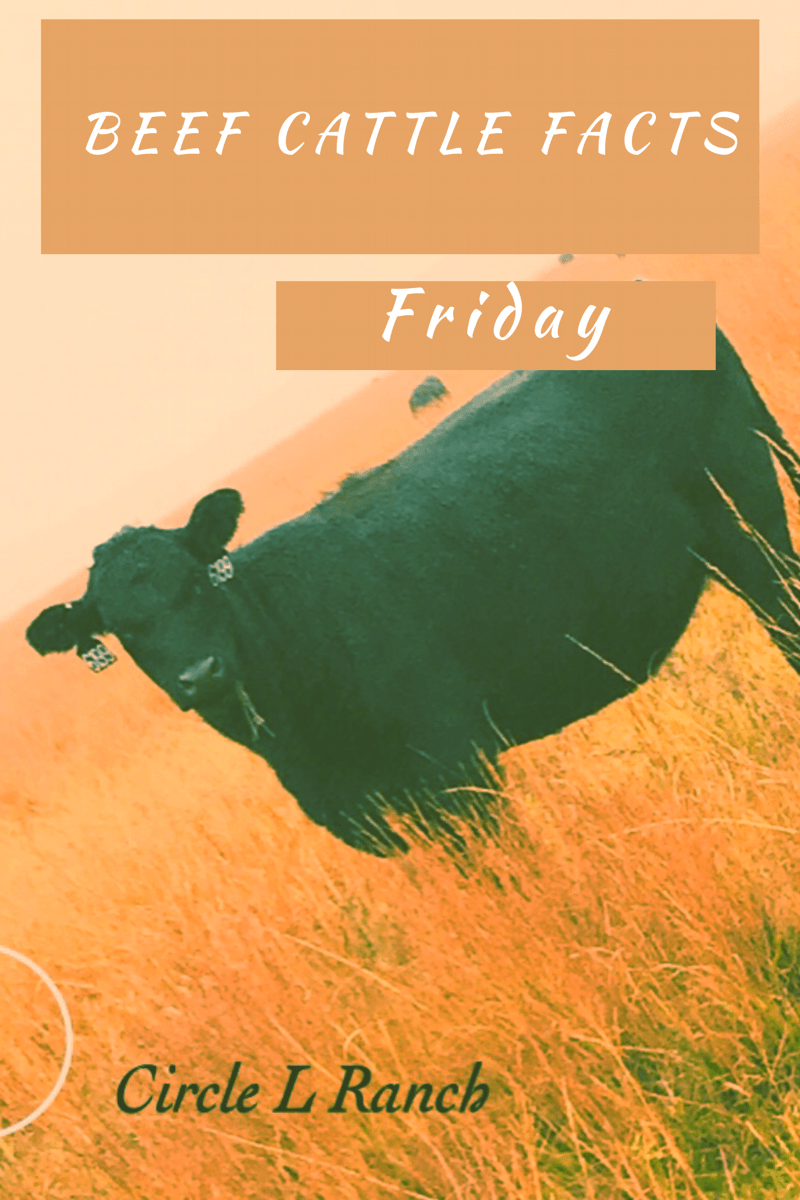
Beef Fact Friday

Beef Fact Friday

Cows.. there’s a lot more to cattle than just a bunch of bessies sitting around chewing their cud. 

They provide milk and meat that our world depends on.

But did you know that domestic cows are actually descendants of wild oxen call aurochs. 

In 2009, scientists mapped out the bovine genome and discovered that cattle have about 22,000 genes; 80% of their genes are shared with humans.  Does that make you say ummm? It did me.

Female beef cattle are called cows.

Male beef cattle are called bulls.

Castrated males are called steers.

Female beef cattle that are young are called heifers.

Cows never sleep standing up. They sleep lying down and about 4 hours a day.

Beef cattle have almost 300 degrees of vision but they can not see right in front of them or behind them.

Beef cattle can not see the color red.

Beef cattle provide us with meat.

Dairy cattle provide us with milk.

Beef cattle can smell up to 5 miles away.

Did you learn anything about beef cattle? Did I miss an interested fact? 

Happy Friday!!

Facts


Categories
Beef Beef it's Whats For Dinner Cuts of Beef Hamburger May is beef month Steak

My 5 Favorite Cuts of Beef

My 5 Favorite Cuts of Beef

In honor of Beef Month, I am sharing with you all my 5 favorite cuts of Beef in no particular order. This list not only contains my favorite cut but also a recipes to go with it.

Here it goes:

1. Hamburger aka Ground Beef..
Where I come from, we call ground beef – hamburger. From tacos to grilling, hamburger is served at the Circle L Ranch almost everyday.  Did you know that by law, hamburger aka ground beef, may not contain any added water, fillers or binders?
My helpful hint about hamburger is that I cook a huge batch of hamburger every week, so that I can make quick lunch and/or suppers.

My favorite recipes come from our Chuckwagon:
Circle L’s Vermicelli
Circle L’s Sauerkraut Burgers
Circle L’s Taco Bake
Easy Taco Salad
Circle L’s Baja Bowls
Circle’s Taco Squares
Chugwater Chili
Circle L’s Beef Enchilada Casserole  

2. Prime Rib Aka Rib Eye Steak..
This cut of Beef makes my month water just thinking about it. I love a good prime rib steak. The prime rib steak aka rib eye has the most fat compared to the other cuts, which is why it’s such a tender, juicy, and flavorful piece of beef. It can be grilled, broiled, or pan-fried with equally delicious results but my favorite is roasted using Pioneer Women recipe.

My favorite recipe comes from: The Pioneer Women Prime Rib

3. Top Sirloin..
This steak is affordable and very flavorful. It’s a relatively lean cut, without a lot of marbling. Top sirloin is often marinated or pounded to help tenderize it. Like the rib eye steak, it can be cooked in any manner. I like to use cut this steak up in cubs and grill it with fruit and/or vegetables.

My favorite recipe comes from:Traeger Grills. You can use your favorite seasoning but we prefer Chugwater Chili Steak Rub or Tom’s Steak Rub.

4. T-Bone..
Did you know that the T-bone steak is really two steaks in one? The T-shaped bone divides a New York strip steak and a tenderloin filet. I like this steak on the Treager Grill.

My favorite recipe come from: The Pioneer Women. This recipe is amazing on T-bones. I mean how could you go wrong with butter and spices on a hot steak.  Try it!!

5. Flat Iron..
Did you know that this steak was found at the University of Nebraska? I was attending a Nebraska Cattlemen Youth Conference in Lincoln, Nebraska when I got to sample this steak.   It has been on my favorite list since then. It is second in tenderness to the tenderloin steak, the flat iron is well-marbled, richly flavored and juicy. Did you know that there are only 2-4 of these steak on a beef animal?

My favorite recipe come from: Circle L Ranch Kitchen. Cook juicy seasoned steak in the skillet to provide a simple yet flavor-packed crust. The trick to a great crust is to use a very hot skillet; a large cast-iron skillet works best. Rub steak evenly with steak seasoning and salt.
Cook in hot oil in a large skillet over medium-high heat 4 to 5 minutes on each side or to desired degree of doneness.(Make sure that you follow the Beef cooking rules. See Below)  Let stand 5 minutes. Cut diagonally across the grain into thin strips.

This list is my favorites. What are your favorites? They all have their strong points, and if cooked properly, you can’t go wrong with any of them. These comparisons may help you choose the perfect cut the next time you’re planning a steak dinner.

Happy Beef Month from the Circle L Ranch.

Beef Cooking Rules to Follow:When cooking Beef, please follow these rules.For safety, the USDA recommends cooking hamburgers and ground beef mixtures such as meat loaf to 160 °F (71.1 °C) as measured with a food thermometer. Cook all organ and variety meats (such as heart, kidney, liver and tongue) to 160 °F (71.1 °C).Cook all raw beef steaks and roasts to a minimum internal temperature of 145 °F (62.8 °C) as measured with a food thermometer before removing meat from the heat source. For safety and quality, allow meat to rest for at least three minutes before carving or consuming. For reasons of personal preference, consumers may choose to cook meat to higher temperatures.For approximate cooking times for use in meal planning, see the following chart compiled from various resources.Times are based on beef at refrigerator temperature—40 °F (4.4 °C). Remember that appliances and outdoor grills can vary in heat. Use a food thermometer to check for safe cooking and doneness of beef. 
Categories
Beef Imported Beef Is Beef Safe USDA

What You Should Know About Imported Beef

What You Should Know About Imported Beef


Hello Readers,

There is a debate going on right now. Do you know what I am talking about? 
NO! Not Hillary or Trump debate. (By the way, can we vote yet? 🙂

The debate that I am talking about today, is about BEEF.

Yep, you see it in the news. You see it on social media. 
You hear about it on the radio. You hear it on the television.
I heard it today when I was in town. 

Is imported beef as safe as U.S. beef? Is it also antibiotic-free? And just how can we be so sure?

I did some research. (Thanks for the help Terrynand Brandi)
This is what you should know.
IMPORTED BEEF IS SAFE!!
All beef (domestic or imported) are inspected by the USDA Food Safety and Inspection Service (FSIS). This is to ensure ALL products are safe, wholesome and have accurately been labeled.
To be imported into the United States, all beef products must come ONLY from certified countries – no exceptions. USDA

All countries and establishments have to become eligible to export. FSIS

All imported products must meet USDA labeling requirements. After those labels are filed with the U.S. Customs and Border Protection, and have met all the requirements of the Animal and Plant Health Inspection Service (APHIS), all beef products must be inspected by FSIS at an official import establishment. 

When beef arrives at the ports, it must be inspected by a FSIS import inspector before it is allowed into our country. The inspector gives it a look at the appearance and condition. The beef is checked for certification and label compliance and inspected by the Automated Import Information System (AIIS). The AIIS assigns other types of inspections including product testing, microbial and chemical analysis.
IS IMPORTED BEEF ANTIBIOTIC-FREE?
Yes. To export to the U.S., the country that the beef is coming from must have a residue control program in place with standards equal to that of the U.S. These programs must sample random animals at slaughter, use only approved sampling and analytical methods, test appropriate tissues for specific compounds, and test for compounds identified by the USDA or the country of origin. 
WHAT SHOULD YOU KNOW ABOUT IMPORTED BEEF?
IT IS SAFE!! 
It doesn’t matter if the beef you eat comes from a local farmer or rancher, the neighborhood grocery store, a chain food store, or from across the seas, you can be sure of this – it is a safe, wholesome and nutritious choice for your family’s table.  


Resource Links:
http://www.fsis.usda.gov/wps/portal/fsis/topics/food-safety-education/get-answers/food-safety-fact-sheets/production-and-inspection/fsis-import-procedures-for-meat-poultry-and-egg-products/fsis-import-procedures
http://www.fsis.usda.gov/wps/portal/fsis/topics/food-safety-education/get-answers/food-safety-fact-sheets/production-and-inspection/fsis-import-procedures-for-meat-poultry-and-egg-products/fsis-import-procedures/!ut/p/a1/jZHRToMwFIafhsuuRebCvCMkZkMHLouOcWM6OC0kwCFtkcynt0NvZoauvTqn33ea_qUZTWnW8o9KclNhy-tznS3e2ZYt3GXIomTpPrJ1_LZNnsKQ-bt7Cxz-AGLvRn9iBew_P7rhgju1CTeSZh03JalagTSVYAhv9QBK01QgFkRzAeZEBM8N0SWAsQedwqLPz1FYuLCq7mAsraMrTaqmQ2WIxXIoegWaCFSkAW572NdGnUYPpCQ_o_SUSfc0u3wKc-1ex95uvopijyXz38CVrL-B6TBtWrLG4_ixh6A9er6NRYEABWrWK9sujen0g8McNgzDTCLKGmY5Ng67ppSoDU0vSdo1r-nnc7Bi1Uuz93XwBQOg3EQ!/#5
http://www.fsis.usda.gov/wps/portal/fsis/topics/food-safety-education/get-answers/food-safety-fact-sheets/production-and-inspection/fsis-import-procedures-for-meat-poultry-and-egg-products/fsis-import-procedures/!ut/p/a1/jZHRToMwFIafhsuuRebCvCMkZkMHLouOcWM6OC0kwCFtkcynt0NvZoauvTqn33ea_qUZTWnW8o9KclNhy-tznS3e2ZYt3GXIomTpPrJ1_LZNnsKQ-bt7Cxz-AGLvRn9iBew_P7rhgju1CTeSZh03JalagTSVYAhv9QBK01QgFkRzAeZEBM8N0SWAsQedwqLPz1FYuLCq7mAsraMrTaqmQ2WIxXIoegWaCFSkAW572NdGnUYPpCQ_o_SUSfc0u3wKc-1ex95uvopijyXz38CVrL-B6TBtWrLG4_ixh6A9er6NRYEABWrWK9sujen0g8McNgzDTCLKGmY5Ng67ppSoDU0vSdo1r-nnc7Bi1Uuz93XwBQOg3EQ!/#6


Categories
Beef Fun Fact Friday health hormones kids

Fun Fact Friday~ Hormones,Beef & Us

Fun Fact Friday~ Hormones, Beef & Us

Beef, Hormones, Family, kids, Health
These Circle L Ranch kid’s health is in my hands right now. I help them
chose what they should eat to keep healthy. I want to make sure that they
are getting their daily amounts of vitamins, minerals and protein. I provide
them with Beef on their plates everyday. Beef is full of healthy vitamins, minerals
and proteins for their busy, growing bodies.
 “HORMONES” “BEEF” & “US”
Hormones, beef and us. It is a touchy subject, but it shouldn’t be.
You see, there are more hormones found in 3 oz of cabbage than a 3 oz. of beef. (1)
As humans, we naturally produce estrogen.
Fruits and vegetables naturally produce estrogen.
SO WHAT IS THE BIG DEAL?
NOTHING. NOTHING at All.
You see, an animal that has been implanted with a growth hormone isn’t going to affect you or your children. The meat you eat from an implanted animal isn’t going to make your daughter or son hit puberty.
HOW DO I KNOW?
Let me explain.
Estrogen is measured in nano-grams (ng). A ng is one billionth of a gram, which is equivalent to one blade of grass in 2 football fields. (2)
We, humans, naturally produce several thousand times the amount of estrogen found in beef. Take a look at this:
An adult women produces 513,000 ng/day
an adult male produces 136,000 ng/day
an women on birth control produces 35,000 ng/day
and our pre-puberal children produces 41,000 ng/day. (1)
WOW, right?
Ok, so now look at this:(3)
A 3oz. serving of potatoes contains 225 ng
a 3oz. serving of cabbage contains 2,016 ng
a 3oz. serving of peas contains 340 ng
or 3 oz. of soy milk that you add to your latte contains 11,250,000 ng
So what are you thinking now?
Do you have more questions?
I would be glad to help or take a look at the references below.
Just a few more thoughts:
A beef animal that has been implanted with a growth hormone provides a healthy meal for all of us. Implants are used in beef to help improve the feed efficiency of the animal, and helps provide a healthy supply of beef using fewer natural resources. Implants in cattle have been approved by the U.S Food and Drug Administration since the 1950’s. (4)
On this Fun Fact Friday, I want to reassure you all that it is our human nature to be fearful of things we don’t understand or are not familiar with. I would encourage you to always do some research and make inquires yourself before believing everything that you read or hear. Misinformation and lies surround us everyday about hormones and beef, but don’t let that detour you from the truth.
Happy Friday, Friends.  The weather here is forecasted to be HOT!! Hello Summer!
My references, check them out.
 
1. http://www.iowabeefcenter.org/information/IBC48.pdf 
2. http://c.ymcdn.com/sites/www.movma.org/resource/resmgr/imported/MVMA_Growth%20Promotant.pdf
3. http://newsroom.unl.edu/announce/beef/2846/15997?utm_campaign=wdn_social&utm_medium=share_this&utm_source=wdn_facebook
 
4. https://www.meatinstitute.org/index.php?ht=a/GetDocumentAction/i/53720
 
5. http://www.beef.org/uDocs/Growth%20promotants%20fact%20sheet%20FINAL_4%2026%2006.pdf
Categories
Beef February Heart Health Month I Heart Beef love Valentine's Day

I Heart Beef!


i Heart Beef from the Circle L!
Valentine’s Day is almost here!
I hope your plans include a romantic dinner with BEEF!
Sure, we might all associate Valentine’s Day with conversation hearts, big red boxes of chocolate and wine. But really, there is something better than that, like a nice chunk of juicy Beef with your Love. I am about to tell you about BEEF, including some of my favorite Beef cuts, and what else you can do for Valentine’s Day.
Why Beef?
Well, February is Heart Health Month and Beef is good for you and your Heart.


Beef with your Love will add:
Vitamins B6 & B12 – For their Brain Functions
Zinc – For their immune system.
Iron – Helps your body with oxygen use.
Choline – Helps their nervous system develop.
Protein – Helps build the muscles and keeps them preserved.
Selenium – Helps protect the cells from damage.
Riboflayin – Helps convert what we eat into fuel.
Niacin – Helps energy production and metabolism.
To read more about the benefits of Beef check out http://www.beefitswhatsfordinner.com

Here is a list of some of my favorite Beef cuts, which also happen to be lean cuts:

 T-bone Steak
 Bottom Round Steak
 Sirloin Tip Steak
 Top Sirloin Strips
 Top Sirloin Filet
 Top Sirloin Kabob
 Top Sirloin Steak, Boneless, Center Cut
Chose your Love’s favorite cut of steak.
If you need a little help in that department, check out Valentine’s Beef on Beef Its What’s for Dinner or head over to my friend’s blog, Faith Family and Beef and check out her T-bone steak recipe. If you don’t feel like cooking, head out to your favorite steakhouse.
This little cowboy Valentine
was given to me by my
late Grandma Beaver!
I love it!!

Whether you like Valentine’s Day or not, I have decided to give you a few pointers on how to make your Love’s Day!!

Along with a good steak, you also need:
a good dessert:)
a good wine,
maybe a few roses,
a candle or two,
maybe a box of chocolates,
and a LOVE letter.

On a personal note, I’m going to do something extra special for My Cowboy. I want to know what you are doing for Valentine’s Day. Leave me a comment. 

With a good steak and a little love, I guarantee that you will have a day to remember!!

Happy Valentine’s Day from the Circle L.

Celebrate Heart Month with a steak of your choice!!


I am celebrating Heart month by enjoying a sirloin steak.
Steak is on the menu for Valentine’s Day, is it on your menu?


Categories
Beef Natural Resources Nebraska water Wildlife

Fun Fact Friday~Beef & Water

A Circle L calf beside a lake provides a classic picture of what God has planned
for us, raising grass for our Beef.
A little Fact/Fiction questions today on the Circle L Blog!!
 
 
Fact or Fiction?
410 Billion Gallons of water are used in the USA per day.
It is Fact. Nearly half of those billions of gallons are used for production of electrical power.(Ref. #1) Humans (Yes, that is us.) we use 80-100 gallons of water a day. (Ref. #2)
Fact or Fiction?
Processing Beef is taking all of our water supply.
It is Fiction.
 
It takes about 441 gallons of water to produce 1 pound of boneless beef. This number is the total of what the animal drinks, the irrigated pasture that the animals may graze, the crops that they animals may consume and the processing of the animal.
According to a study published in 2011 in the Journal of Animal Science, the amount of water used to raise beef today compared to 30 years ago has been reduced by 12 percent.
According to previous research, it takes 226 more days for grass-finished cattle to reach market
weight than grain-finished cattle. More days on grass may mean greater environmental impact. For example, compared to grass-fed beef, grain-fed beef uses 76 percent less water.(Ref. #1)
In my opinion, we the people seem to be using a lot of water. For instance, a 5 minute shower uses 10-25 gallons of water. And it takes 39,090 gallons of water to manufacture a new car.  ( Ref.#3)
Raising beef requires the use of our natural resources that God has given us like land, water and energy. Thank you to all the farmers and ranchers who raise beef with fewer natural resources, including water, than we have ever before.
One thing we do on the Circle L Ranch is that we work with our soil and water conservation district to manage our soils and water. We also use windmills and other natural water sources to water our Circle L cattle and all of the wildlife that roams our ranch.
Happy Friday, Friends! I am headed to the Rapid City Stock Show to attend a feed meeting. What will you be doing this weekend? Watching the Super Bowl?


Categories
Beef Beef In Schools

Fun Fact Friday~Beef in Our School

Fun Fact Friday~Beef in Our Schools

I am a mother, I care about what my kids eat and I am proud that
my kids get Beef on their lunch plates.
My Fun Fact Friday is all about BEEF; beef in our school lunches. As a lot of you know, I was appointed to a board in the Nebraska Cattlemen to help get the word out about Beef in our Schools.
Today I thought I would answer some questions that I have been receiving.
How can you get Beef in your Schools?
The first step would be to contact your superintendent and ask him/her if they would be willing to present it to your school district board.
The second step would be to get your community involved. Ask for animals to be donated. Ask for donations for the processing.
The third step would be to check out your closest USDA inspected processing plant and see if they would process your donated animals.
The fourth step would be to talk to your head school cook.
“At Bridgeport Schools we are very proud of being in an agricultural based community and realize that without all of the agricultural property in our district, our school could not operate. One idea that has come up that would show this pride; is if we were able to serve beef that was raised locally and USDA approved. 
One way we believe we can do this, is by having beef raised by local producers donate to be processed at KDK Meats.  Many will say that area cattle producers already give enough to the school district through property tax.  Which is very true, but we have had several area producers say they would be interested in donating a cow/fat steer if that meant locally raised beef would be served at Bridgeport Public Schools.”
“The program would work this way.  If a beef raised by local producer was donated to be processed, the donor would have their name put in our monthly newsletter as the “Beef Provider of the Month” and this would also be on a sign in the cafeteria.  Starting this fall our monthly newsletter will be bulk mailed and every mailbox in our district will receive one.”
“We realize timing can be very important in donating an animal so we would be very open to working with the producer’s production schedule.  We believe we will need about 12 beef a year to make this work.  The school will pay for the processing and will look for a grant that might help cover that fee.  However, if you are thinking “I don’t raise cattle, but I would love to donate for the processing of an animal” then just let us know and we can make that happen. Also some have mentioned buying one at the fair and donating it.” 
~Chuck Lambert, Bridgeport Superintendent 
How do you make this program successful?
To make this program a success, as it has been in Morrill County, is to have community support that believes in our school system and our youth for tomorrow. Our community is the key to our success.
Suggestions:
Contact the president of your local affiliate of the Nebraska Cattlemen.
Contact the  president of your local fair board.
Contact your local newspaper.
Contact your local businesses.
Ask them all to help spread the word about Beef in your School.
Make sure that you advertise your producers, businesses, individuals that have donated. (School Newsletter, School website, giveaways at games, etc.)
 
FOR YOUR INFORMATION:
This program will not effect your free/reduced lunch program.
You don’t have to go through procurement.
I would like to Thank all the local Beef producers for donating animals to our school lunch program. They include:
Lapaseotes Feedyard
Phil and Joan Corman
Weborg Feedlot, Inc.
Justin and Becky Corman
Pohl Family Farms
RBA Farms—Amateis
3L Farming and Feeding –  Peter G and Jim Lapaseotes
Steel Grill/Troy & Lisa Weborg
Faessler Farms
Mark, Ryan & Jaz Livingston
Trail Animal Clinic—Phillip & Kristen Kesterson
The Kraupie Family
Dale & Tammi Nichols
“My family and I have received a good education from Bridgeport Schools, we believe in the Ag program and the administration and the Beef program is a way to give back to our community.” ~Dale & Tammi Nichols, Beef Provider of the Month
Total to date, Bridgeport Schools has had a total of 24 locally raised Beef donated; that is about 19,200 pounds of locally grown BEEF.
Why is this important?
Beef in our lunch programs is so important because our growing kids need a healthy lunch.
By serving Beef in our lunches, our kids receive:
Vitamins B6 & B12 – For their Brain Functions
Zinc – For their immune system.
Iron – Helps your body with oxygen use.
Choline – Helps their nervous system develop.
Protein – Helps build their muscles and keeps them preserved. 
Selenium – Helps protect their cells from damage.
Riboflayin – Helps covert what we eat into fuel. 
Niacin – Helps energy production and metabolism. 
To read more about the benefits of Beef check out http://www.beefitswhatsfordinner.com for more information.
Do you have more questions? Feel free to ask!

Happy Friday, dear friends!!

Categories
Beef Chili Chugwater Chili Cold Nights

Circle L’s Chuck Wagon~Chugwater Chili

Chuckwagon Recipe from the Circle L- Chugwater Chili


Chugwater Chili, Chili, Circle L Ranch

Chugwater Chili Spice.

Chugwater is not only my home town it is the home of the famous Chugwater Chili.  The founding of Chugwater Chili Corporation is a story of real small town values at work.  Chugwater Chili Corporation was formed by a bunch of my neighbors in 1986.  They purchased the Wyoming State Championship Chili Recipe, with the goal of helping the business community in Chugwater. 
 I love Chugwater Chili!  
It is a spice that I use on almost everything I cook.  Beef and Chugwater Chili are a perfect match!  A bowl of Chugwater Chili warms your soul. To order please see their website:  http://chugwaterchili.com/index.html See below for Chugwater Chili Recipe.


If you are interested in the history of Chugwater see their site: http://www.chugwater.com/history.asp 


CHUGWATER CHILI


My Pot of Chugwater Chili.
The Smell of Chugwater Chili is amazing.

2 lbs Ground Beef
3 Tbsp of Chugwater Chili Mix
1 15oz can tomato sauce
2 15oz Plain Pinto Beans
Cheese and Crackers

Brown 2 lbs of ground beef; drain excess fat. Stir in 3 Tbsp. Chugwater Chili Mix (more for hotter chili), one 15 oz can tomato sauce and 15 oz water.
Bring to a boil. Reduce heat, cover and simmer 30 minutes, stirring occasionally. Add two 15 oz cans plain pinto beans; return to simmer. Serve Hot. Recipe makes 9 one cup servings

Some extra advice:

I serve Chugwater Chili with Cheese and Crackers.  I also sometimes add a can of diced canned tomatoes into my chili.
Left over Chugwater Chili can be used for Chili Dogs, Chili Frito’s with cheese and Taco Salad.

I sell Chugwater Chili at Double A Feeds.

I rarely have left overs but when
I do, the second day is
even better!

(Please note: Please follow safe handling of Beef)

Categories
Beef Beef it's Whats For Dinner Circle L Chuck Wagon

Circle L’s Chuck Wagon-Beef Taco Squares

Circle L’s Beef Taco Squares from the Chuck Wagon

This casserole dish is a huge hit at our table.
We really like Tortillas so this is a big hit with the kids and
My Cowboy!!
I am always creating and trying new, fast dishes at our place.  With the kids being in school and after school activities I don’t have much time to wait on supper.  I really like this dish because I can put it in the oven and in 30 minutes it will be ready to eat.  Another thing I do is cook up hamburger on the weekends, so then I can just add the cooked hamburger to any dish and it cuts the cutting time in half. Let me know what you think of this recipe.
My family gave it “Thumbs Up”!

Circle L’s Beef Taco Squares

2 lb. of Ground Beef, browned and seasoned to your taste. (I use Chugwater Chili)
2 Can of Black Beans ( I use chili black bean)
1 jar of Corn Salsa (I have used homemade salsa)
10-15 Tortillas, cut into bite sized pieces (I have used both corn or flour)
3 cups Cheddar or Mexican blend cheese, shredded
Mix all the ingredients together in a large bowl.
Pour into a 12 x 18 casserole dish that has been sprayed with cooking spray.
Cover and bake at 350 degrees for 30-45 minutes.
Notes:
This recipe could be doubled and halved.
I served it with Fresh Spinach.
Let me know if your family likes it!
Categories
Baja Bowl Beef Chugwater Chili Circle L Chuck Wagon

Circle L’s Chuck Wagon- Baja Bowls

Circle L’s Baja Bowls

Circle L’s  Baja Bowls are becoming very popular at our place.


3 lbs. of Ground Beef, Cooked and drained
1 TPS Chugwater Chili or Taco Seasoning
1 Can of Sweet Corn, drained
1 can of Black Beans, drained
8 Cups of Cooked Rice ( I use Minute Rice)
Diced Tomatoes, Avocado, Cheese and Onions to taste
Lime juice to taste
Cook rice according to package.

Brown ground Beef until fully cooked at 155 degree F. Drain the fat off. Mix Chugwater Chili or Taco Seasoning with ground beef. Add corn and black beans. Stir until fully mixed, over low heat, to combine all ingredients.

Fluff rice with a fork.  Serve in a bowl.  Top rice with meat mixture, then add a few drops of lime juice if desired.  Add diced avocado, tomatoes, onions (if desired) and Cheese.

I serve with tortilla chips!

Enjoy!

This dish has become a family favorite!!